| Central Souq | |
Sharjah
With 600 shops, the Central Souq is the biggest of Sharjah's markets. It's a good place to look for local flavors of antiques, rugs, jewelry, perfumes and textiles.
|
|
| Deira | |
Dubai
The historic neighborhood of Deira is home to Dubai's most famous souqs (a souq is a commercial quarter in an Arab city). Look for the Gold, Spice and Perfume Souqs, open from late afternoon and into the evening.
|
|
| Airport | |
Dubai
It's the busiest air hub in the Middle East, and has seen a two-digit percent increase in passenger numbers every year for the last ten years. Many visitors to Dubai never get further than its famous duty-free.
|
|
|
|
| Middle East | United Arab Emirates |
United Arab Emirates: Yesterday Tomorrow
The United Arab Emirates (UAE) is a crossover between the traditions of the Bedouin lifestyle and the fast pace of the 21st century modern life. Its an odd mixture of religious conservatism and Western consumerism. The UAE's seven emirates are each ruled by its own sheikh (under a federal government), but the real drive of the country is its oil fields, which make up the third largest reserve of oil in the world. Though, in these days the UAE is gazing to times beyond the era of oil, with heavy investments in trade and tourism. |
 |
 |
Dubai: The Creek
Dubai is really two towns merged into one and divided by Dubai Creek (Khor Dubai), which is an inlet of the Arabian Gulf. The two neighborhoods on either side of the creek form the historic heart of the city, and this is also where you'll find most of the attractions of Dubai. The two neighborhoods are Deira to the northeast and Bur Dubai to the southwest. The small motorboat taxis, called abras, take you across for one dirham. |
Dubai: Dhow Wharfage
Dhows are the traditional Arab sailing vessels, and can be seen along the coasts of the Arabian Peninsula, India and East Africa. The dhow wharfage on the Deira side of the Khor Dubai (Dubai Creek) gives an up-and-close view of these graceful wooden ships and the endless flow of cargo being loaded and unloaded. As late as the 1960s dhows would bring their cargo all the way from the Persian Gulf to East Africa using only sails to "power" themselves. |
 |
 |
Dubai: Jumeira Mosque
Jumeira Mosque (on Al-Jumeira Rd.) is not only the largest mosque of Dubai (with room for 1200 worshippers). It is also the only functioning mosque in the United Arab Emirates which is open to non-muslims, though only for one-hour tours on Sundays and Thursdays at 10am. Built in the medieval Fatimid tradition, it is an impressive example of modern Islamic architecture. It was completed in 1978, built by order of His Highness Sheikh Rashid bin Saeed Al Maktoum. |
Dubai: Al-Fahidi Fort
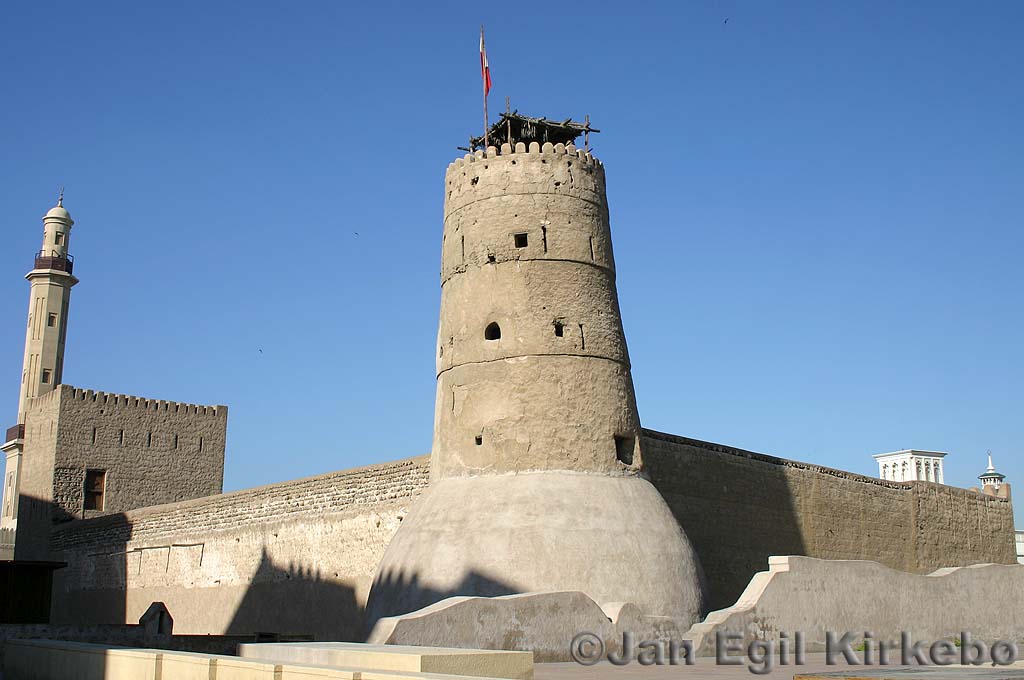
Perhaps the oldest building in Dubai, the Al-Fahidi Fort dates back to 1787 and was built as a defense against foreign invasions). Since a renovation in 1993 it houses the Dubai Museum. The museum gives insight into the heritage of Dubai as well as desert life. One of the hightlights are artifacts excavated from graves dating back to the third millenium B.C. The museum is a must for any first-time visitor to Dubai (open everyday except Sundays) . |
 |
 |
Dubai: Burj al-Arab
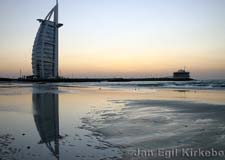
Built to resemble the sail of a dhow, the Burj al-Arab (meaning Tower of the Arabs) has been promoted as "the world's first seven star hotel". The hotel has quickly become a symbol of the modern and luxurious Dubai. Even though the building has the same height as the Eiffel Tower (at over 300 meters) it only holds 28 double-storey floors, with a total of 202 bedroom suites. Prices for the suites start at $1000 per night. |
|
|
| Khaled Lagoon | |
Sharjah
Sharjah is Dubai's conservative cousin. It promotes itself as the cultural capital of the United Arab Emirates. Its souqs make for some of the best shopping in the country.
|
|
| Facts | |
Al-Imārāt al-ʿArabiyyah al-Muttaḥidah

Capital
Abu Dhabi
Largest city
Abu Dhabi
Population
2,602,000 (2006)
Area
83,600 km²
Official language(s)
Arabic
Government
Federal constitutional monarchy
|
|
| History | |
United Arab Emirates
•Middle Ages: Part of the Kingdom of Hormuz.
•1498-1633: Portuguese arrive and set up taxation of Gulf trade.
•1820: British impose the Maritime Truce on nine sheikhdoms in the area.
•1958: Oil is found in the Abu Dhabi emirate.
•1971: The United Arab Emirates (UAE) is formed with six of the seven current emirates.
|
|
|